
Knowledge, Good and Evil
A sermon given by Sheldon Greaves, Ph.D., at the Episcopal Church of the Good Samaritan, 20 February 2026.

Well, I gotta hand it to Father David for asking me to preach today because our reading from Genesis is a doozy. Chapter three in particular is one of those where a scholar starts at the beginning and before you know it you have enough material for a 200-page commentary. And then you move on to verse 2.
But let’s start with Adam, the gardener, and the trees in the Garden of Eden. All of them are good for food except one, the Tree of Knowledge of Good and Evil. Actually, that’s not true. This tree is good for food, but it’s off the menu. Now the name here is important. It is not the Knowledge of Good or Evil, or Knowledge of Good from Evil, but Knowedge of Good and Evil. Why is that important? The name is what your English teacher would have called a merism. It’s a phrase that is all-inclusive like, “come one, come all!” “Age nine to ninety!”; that sort of thing. In other words, it was the knowledge of… everything.
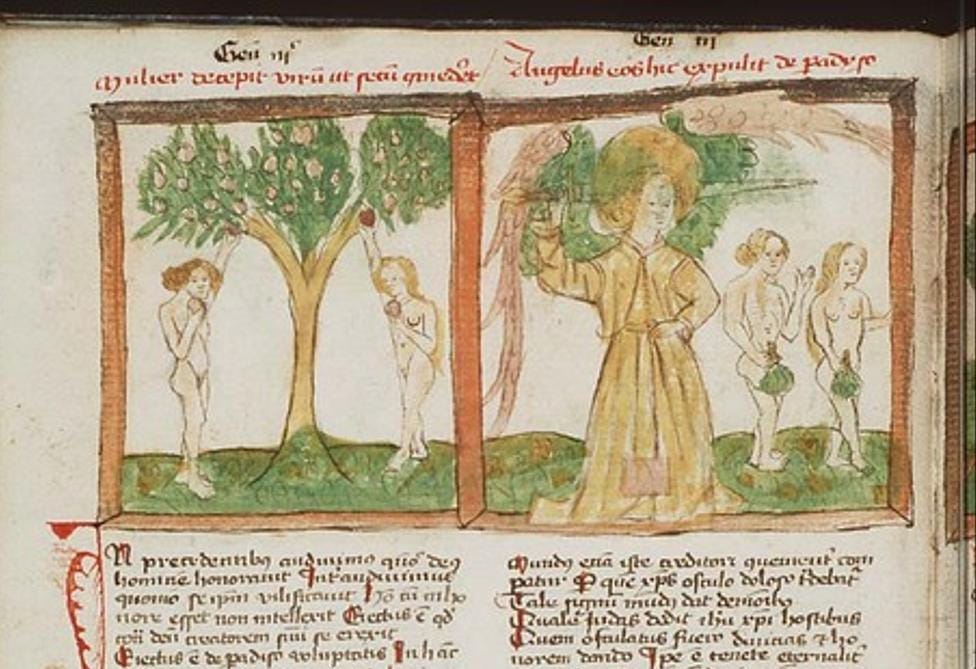
One of the many difficulties with this text is that over the centuries it has accumulated a lot of excess baggage that served some purpose at one time or another, but it has also clouded the text with some false assumptions. To take one example, if you or I walked into any church or synagogue in the land and said, “The serpent in the Garden of Eden is Satan,” no one would argue with you. The problem is that nowhere in Genesis is the serpent identified with Satan. In fact, nowhere in the entire Old Testament do we find that connection. The first we hear of it is in the Wisdom of Solomon, which was composed sometime in the first century BCE. So, Eve was tempted, but not by Satan. This is important, because some strands of theology use this misconception to argue for a mildly satanic flavor to seeking knowledge; that it sets up worldly wisdom against the mind of God, or that curiosity leads to intellectual hubris. We see some of this thinking today among those who oppose secular education on religious grounds. Others, like the Gnostics, took the opposite view, that knowledge is what saves us.
Another assumption we have to dispose of is the idea of God as all-benevolent, all-knowing, and all-powerful. That’s another late development. The God we find in Genesis is not that God. This one is moody, jealous of his domains, capricious, kind but ruthless, often terrifying, and sometimes dangerous.
God is also not above prevaricating when it comes to this tree. When he warns Adam and Eve that if they partake of the forbidden fruit they will certainly die, the language he uses is the same as we find in legal sections for capital punishment. It happens pretty much right away. The perp doesn’t get to enjoy several centuries of life before shuffling off his mortal coil. In the view of many interpreters God is also jealous of his power; he knows that if humans get their hands on that fruit and everything that goes with it, they will be like the Gods. And that is a reasonable interpretation. I also find it fascinating that in Genesis, one thing that apparently distinguishes humans from divinity is the knowledge of good and evil. But that’s an entirely different conversation.
And yet while pondering these passages, I caught myself thinking that maybe it wasn’t jealousy so much as apprehension on God’s part. Could he have worried about what sort of chaos would be unleashed on his creation as humanity muddled its way through the process of knowing good and evil? Perhaps I could liken it to having a houseplant in our home that, if our three cats decided to eat it, they would suddenly acquire opposable thumbs. The consequences would not be pretty. Consider how things went mostly downhill after humans ate that fruit; Genesis 6:11 tells us that ‘The earth was corrupted before God, and the earth was filled with violence.” One can perhaps understand God’s reluctance.
But this leads us to another matter, which is the ancient Hebrew idea of knowledge and how one goes about getting it. The word “to know”1 usually refers to knowledge gained by direct, lived experience rather than by reading or studying or meditation. You gain this knowledge the hard way, by getting your hands dirty, by making mistakes, taking hard knocks and occasionally, gradually, getting things right.
This brings us to the serpent, the cleverest of God’s creatures. I won’t say much more about it, except that there is a wonderful pun2 happening when Genesis describes the serpent as “cunning” or “clever.” The word is a very close pun on the word for “naked.” It ties neatly with how Adam and Eve discover at roughly the same moment, that they are both clever and naked.
And finally, we come to Eve, who for thousands of years has taken the heat for setting all this in motion—very unfairly, I believe. A former professor of mine was a kindly gentleman who only needed some extra facial hair to be indistinguishable from Santa Claus. He had a temperament to match. But I heard him lecture on this passage to a class of seminary students and actually saw him get angry—really angry—at the idea that these verses were used as an excuse to oppress women. I share that view.
In the religious tradition of my youth, we were taught that Eve is not the villain of the story but in a real sense she’s the hero. She recognizes that the Garden is a paradise, but a stagnant one. In order for humanity to progress, it was necessary to advance beyond simply following instructions. What was needed was independence; the mind to conceive, the will to direct. Yes, it was a transgression, but we were taught that the transgression was a matter of timing. They ate the fruit at wrong time, although no one ever explained when the right time was.
Eve was not naive. She looked at the Tree of Knowledge of Good and Evil, and she saw that it was beautiful, that it was good for food, and it was desirable to make one wise. She also grasped that knowledge comes at a price, and that sometimes that price is very high. She weighed what was at stake, and she made the hard choice.
I have come to see this pivotal event in the primeval history as something other than some Fall that got twisted into some really bad ideas like sexism or original sin. Instead, I now see it as the final step in the creation of humanity. It was the moment when we become fully human, with a touch of the divine. Eve’s name, in Hebrew is Chawa, which means, “life.” In crossing the line and taking that crucial step, she enlivened and effectively gave birth to humanity as a mindful, thinking, knowing entity. It is true that things got messy. That is the natural consequence of coming to know good and evil. Humans turned out to be clever, but also nasty, vain, and homicidal. They could also be noble, kind, selfless, and creative.
And so we learn, or try to. We lurch from knowing to knowing, often getting it wrong, but for all that, we can still cherish the gift that we can know and learn and, in so doing, become just a little lower than the angels.3
Amen.
Check out my new book, The Guerrilla Scholar’s Handbook.
Notes:
1 “To Know”, יָדַע , Theological Dictionary of the Old Testament, Vol. V, Botterweck and Ringgren, eds., David Green, trans., (Grand Rapids, MI: Eerdmans Publishing Co.), 1986, pp. 448ff.
2 See Zvi Ron, “Wordplay in Genesis 2:25-3:1” Jewish Bible Quarterly, Vol. 42:1 (165), Jan.-Mar. 2014, pp. 3-4.
3 Psalm 8:5
Intriguing. The myth of the 'fall' of mankind has always intrigued me, but I've never been a big fan of Patriarchal Christianity's unfortunate habit of blaming women for (almost) everything. As I may have mentioned before, my bias is with Gnostic Christianity, which has a slightly different take on Eve, to wit, from ChatGPT: "Some Gnostic texts.... equate Eve with Sophia, who seeks to restore lost knowledge. Thus, her act of taking the fruit is a reclaiming of wisdom, suggesting that divine knowledge is inherent to humanity and must be awakened."